Precision Agriculture Technician
Agriculture
Apply geospatial technologies, including geographic information systems (GIS) and Global Positioning System (GPS), to agricultural production or management activities, such as pest scouting, site-specific pesticide application, yield mapping, or variable-rate irrigation. May use computers to develop or analyze maps or remote sensing images to compare physical topography with data on soils, fertilizer, pests, or weather.
You can enter this career straight after SPM. A degree is optional, not required.
Picture the job
Where you'd usually workA farm or plantation
- Outdoors most days, in all weather
- Shifts or irregular hours
- A noisy workplace
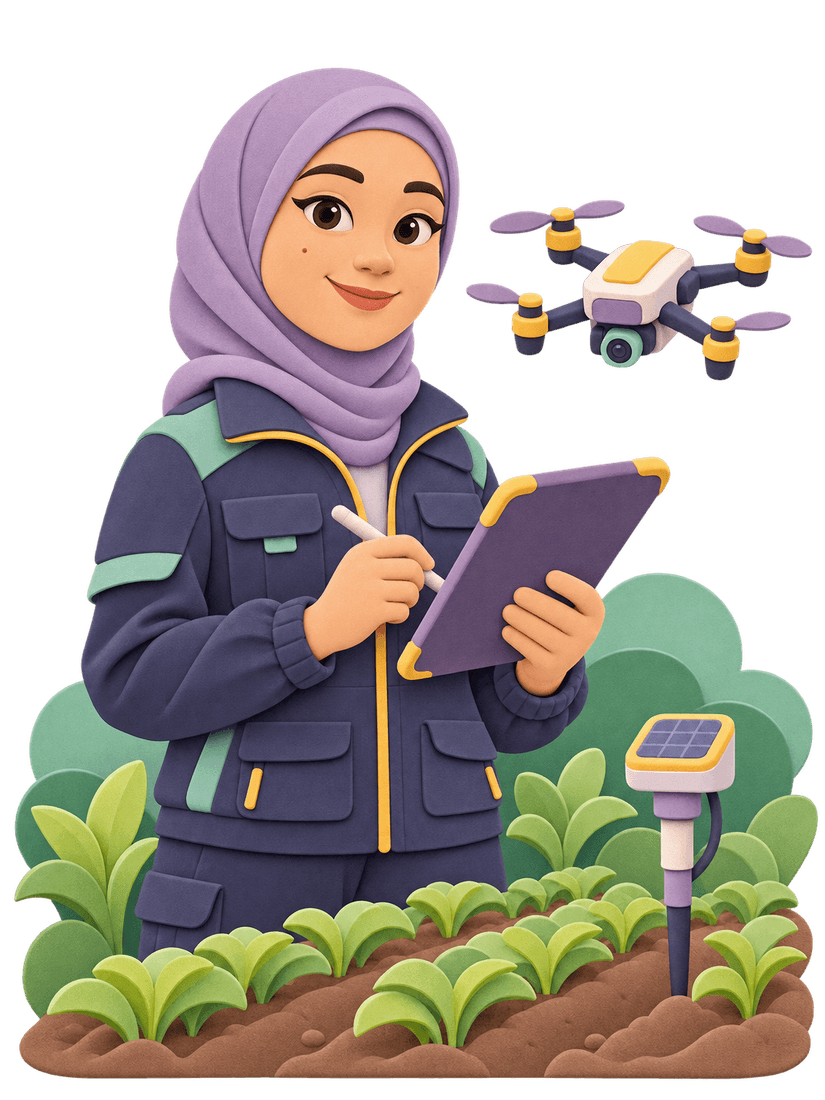
An illustration of a typical workplace, not a photo. The work-style notes come from US O*NET data, so read them as a guide.
Pay in Malaysia
We don't have a sourced Malaysian salary range for this job yet, and we'd rather show nothing than a number we can't stand behind.
Where to check:
- JobStreet and Hiredly job ads for this title
- DOSM Salaries & Wages Survey
- SSPA scheme tables, if you're aiming for a government post
How far is this from you?
Roughly how much preparation this job usually takes. In Malaysia your UPU route and the programme's syarat still decide entry, so treat this as a guide, not a gate.
1
Entry straight after SPM
2
SPM + sijil / short TVET course
Typical entry
Diploma / TVET (sijil–diploma)
4
Degree (ijazah sarjana muda)
5
Postgrad (sarjana / PhD) or professional route
How to get here
Post-SPM pathways with programmes in this career's fields. Tap one to see real programmes and entry requirements.
Asasi / Foundation
One-year runway into a specific university: public via UPU or private direct entry.
Diploma
Skill-first qualification. Work after, or enter degree Year 2. Polytechnics keep it affordable.
Check what you may qualify for
Enter your SPM grades and see which routes and programmes you may qualify for. An estimate to plan with, not an offer.
Quick answers
How do you become a Precision Agriculture Technician in Malaysia?
Routes after SPM that lead here include Asasi / Foundation and Diploma.
Can I become a Precision Agriculture Technician straight after SPM?
Yes. This career can be started with a certificate, diploma or TVET training straight after SPM, without a degree.
What should I study to become a Precision Agriculture Technician?
Related fields of study: Agriculture and Data Science. SPM subjects that help most: Computer Science / ICT, Electrical & Electronic Eng. Studies, Business and Economics.
How much does a Precision Agriculture Technician earn in Malaysia?
We don't yet have a Malaysian source we can cite for Precision Agriculture Technician pay, so we show no figure.
Biotechnology & STEM · Career guide
Precision Agriculture Technician
Uses geospatial technology and data to support agricultural management.
Work overview based on O*NET occupation sources; Malaysian study examples and context are linked below. Actual requirements depend on the programme and post.
What does the work involve?
- Use GIS or GPS in agricultural work.
- Develop and analyse maps or remote-sensing images.
- Compare soil, crop or farm-condition information.
Work settings and skills
Field and computer work for farm mapping and management.
- Reading Comprehension
- Active Listening
- Speaking
Study areas and planning after SPM
Agriculture, geoinformatics, remote sensing or agricultural technology.
Planning example: SPM → agricultural, geospatial or technical study meeting a post's requirements → technical-support applications. Check the employer's actual requirements.
UPM describes precision farming, GIS and remote sensing; UTAR's Agricultural Science programme also covers digital agriculture and field learning.
These are study areas to explore, not verified admission rules for every programme. Check special requirements, recognition and curriculum directly with the institution.
Further study and professional checks
Choose further study according to the area you want to deepen and the post's requirements. Compare coursework and research modes and read the university's admission criteria.
Check the actual vacancy before treating a qualification as sufficient. Study or training does not guarantee admission or employment.
What you'd do all day
The tasks that matter most in this job, most important first.
Also known as
What this job is called on JobStreet, LinkedIn and in job ads. Search these too.
Subjects that matter here
The SPM subjects worth your effort for this career, with the reason for each.
What you'd need to know
The subject areas this job leans on most, and the SPM subjects that build them.
- Customer and Personal Service83%
- Computers and Electronics82%
Computer Science / ICTElectrical & Electronic Eng. Studies
- Sales and Marketing70%
BusinessEconomics
- Mathematics70%
Additional MathematicsMathematics
- English Language70%
English
- Engineering and Technology69%
PhysicsAdditional MathematicsDesign & Technology (RBT)
Tools you'd use
Software and equipment that show up in this job, worth learning early.
What the work feels like
Day-to-day working conditions, so you can tell whether the job suits how you like to work.
- Face-to-face discussionsEvery day
- Contact with other peopleConstant contact
- Handling conflict situationsRarely
- Outdoors, in all weatherEvery day
- Noisy environmentOften
- Time spent sittingA little
- Time walking or movingA little
- Hands-on work with tools or objectsAlmost all the time
Where this job is heading
Newer tasks O*NET has flagged for this occupation, a hint at how the role is changing.
- Operate drone technology to capture aerial imagery and data for crop monitoring and analysis.
AI and demand for this job
A few real, dated data points, not a single score. AI making some tasks faster usually means a job changes, not that it disappears.
Share of everyday tasks today's AI can already help with (2023)
This estimate is from 2023, already out of date, since AI moves fast. Treat it as a rough, aging starting point, not the current picture.
What beginner adverts asked for
We read 46 internship and fresh-graduate adverts in related fields (August 2026). A small sample from one job site, not every vacancy.
21 of 46 were internships
Allowance or pay, when stated
RM1,475 – RM3,500
22 of 46 adverts printed an amount: usually between RM1,475 and RM3,500 a month. Many print none.
Minimum CGPA asked
3.00 to 3.50
Stated in 4 adverts. Others did not state one.
Languages named
Bahasa Malaysia, Mandarin
An empty line means the adverts did not say, not that employers have no requirement. Check each employer's own advert before you plan around it.
Related careers
If this interests you, these are worth a look too.
About this information
This describes what the job involves. Pay, demand and entry routes differ in Malaysia, so check the Pathways and Programmes pages for local requirements.
O*NET occupation: Precision Agriculture Technicians
Job responsibilities, knowledge areas and work context from O*NET 30.3, US Department of Labor, used under CC BY 4.0. onetcenter.org